Park the Bus: Israeli Election Count Leaves Netanyahu and Opposition Blocs Without a Majority
About this newsletterBeta
Radical Relay is a daily brief on markets, geopolitics, and Washington, sent every morning before the open. Subscribe free.
Radical Relay is in beta: sections and formatting are still changing, and a reply saying what looks wrong is the most useful thing a reader can send. Already a reader? Forward this to someone who would use it.
 The Big Picture

Ballot counting in  Israel's general election shows Prime Minister Benjamin Netanyahu’s bloc leading over Gadi Eisenkot’s opposition coalition, though neither side has secured the 61 seats needed for a parliamentary majority (NYT World). In
 Spain, at least 10 people died after two high-speed passenger trains collided near Toledo, sending two carriages down an embankment (NPR). Washington alerted several Persian Gulf allies that the U.S. may launch a renewed military operation against
 Iran following the Nov. 3 midterm elections (Militarnyi). Meanwhile, the
 Netherlands committed €1.2 billion in non-military aid over the next three years to finance
 Ukrainian reconstruction and support bilateral trade (Ukrainska Pravda).
Key Markets & Economy · Conflict & Security · Washington & Politics · Energy & Climate · Tech & Science · World — link colours follow these themes throughout
 MACRO PULSE & PRICE TRACKER |
Futures +0.13% since the close • 30D +0.51%
|
This morning, before the open • 30D range 14.8–20.0
|
||||||||
$40.53T
$119,201 per citizen • $300,210 per taxpayer
|
3.75% – 4.00%
EFFR: 3.88% • Standard Policy Decision
|
||||||||
Safe Haven & Central Bank Reserves
|
▬ 10Y ▬ 30Y • Spread +31 bps • unchanged on the day • was +32 bps on 28 Sep
|
||||||||
WTI: $101.53 • Brent 30D range $100–$117
|
Global Carry Trade & FX Liquidity
|
 S&P 500
 VIX Volatility
 US National Debt
 Gold (XAU/USD)
 Crude Oil & Hormuz
 USD / JPY (Yen)
 Trending Cycles
Soaring Maritime Fuel Costs Force Suspension of Residential World Cruise

- Voyage Halted: Residential cruise operator Villa Vie Residences suspended operations of its vessel Villa Vie Odyssey in Cambodia after sharp increases in marine fuel prices pushed the company into financial restructuring (gCaptain).
- Passenger Arrangements: Operators are coordinating temporary accommodation and travel options for stranded long-term residents as the ship remains docked (BBC World News).
Ukraine Launches Experimental Satellite Ahead of Starlink Speed Restrictions
- Orbital Test: A Ukrainian tech startup launched an experimental communications satellite aboard a SpaceX Falcon 9 rocket to test hardware for an independent satellite constellation (SpaceNews).
- Tactical Context: The launch occurred two weeks before Starlink imposed bandwidth speed caps affecting Ukrainian military drone operations across frontline sectors (Euromaidan Press).
Rising Fuel Costs Hit Commercial Maritime and Small Business Operations

- Energy Earnings Surge: Energy giant Equinor reported third-quarter adjusted net income tripled to $2.86 billion, citing elevated natural gas prices, strong refining margins, and higher hydrocarbon output (OilPrice.com).
- Commercial Impact: Diesel price increases continue to compress margins for Gulf Coast shrimpers and freight transport operators who rely heavily on refined distillate fuels (The Bulwark).
 The Radar
This Week in Congress & Capitol Hill Watch
- House Session Status: The House of Representatives is not currently voting, having last recorded a floor vote on Sept. 16, 2026 (House Clerk). Eleven members have missed significant portions of recent votes; Reps. Neal Dunn, John Garamendi, Cory Mills, Tom Tiffany, and Steve Womack each missed 14 of the last 14 roll calls, with official logs showing no specific reason for their absences.
- Senate Session Status: The Senate is not currently voting, with its last recorded vote taking place on Sept. 30, 2026 (Voteview). Sen. Dan Sullivan missed 8 of the last 14 roll calls (a 57% absence rate), with no reason recorded in the roll call log.
- Floor Legislation & Committee Work: Before recessing, the House passed S. 2403 (Retire through Ownership Act) and H.R. 9497 (Water Resources Development Act), while the Senate confirmed Keith Sonderling as Secretary of Labor (Senate Roll Call). Neither chamber has active committee markups or hearings listed on the public schedule this morning.
 US Politics & Election Watch

- Election Countdown: The 2026 midterm elections are six days away on Nov. 3, 2026, with all 435 House seats, 35 Senate seats, and 36 state governorships on the ballot.
- National Polling Data: A PBS News/NPR/Marist poll published Oct. 27 indicates Democrats hold an 8-point lead over Republicans on the generic congressional ballot among likely voters, growing to a 13-point lead among independent voters (PBS NewsHour).
- Voting Rights Litigation: A Ninth Circuit Court of Appeals 2-1 decision denied a Department of Justice request for expedited action in a California voter registration lawsuit, referring the matter back to a district court hearing (Law Dork).
Ukraine War & Frontline Watch

- Reconstruction Commitment: Prime Minister Rob Jetten confirmed the Netherlands will provide Ukraine with €1.2 billion in non-military assistance over three years to fund infrastructure repairs (Ukrainska Pravda).
- Public Opinion Poll: Data from a Kyiv International Institute of Sociology survey shows 80% of Ukrainians favor ongoing strikes on
 Russian oil refineries even if foreign aid decreases, with 63% willing to endure prolonged conflict (Ukrainska Pravda).
- Industrial Facility Strike: Ukrainian unmanned aerial vehicles targeted the Novomoskovsk Azot chemical plant in Russia's Tula region, starting a fire at a facility producing precursors for military explosives (Militarnyi).
Iran, Hormuz & Middle East Conflict Watch

- Regional Military Operations: The United States informed Gulf partner nations of potential military strikes against Iran following the Nov. 3 midterms, repositioning regional forces and transferring a Patriot air defense battery (Times of Israel).
- Ceasefire Negotiations:
 Qatari envoys presented Iranian leaders with a new draft agreement containing a seven-day timeline to stop armed conflict with American and Israeli forces (Al-Monitor).
- Maritime Environmental Impact: Crude oil leaking from a damaged tanker in the Strait of Hormuz made landfall along beaches in the
 United Arab Emirates, prompting emergency closures (Al Jazeera).
 Macro & Monetary Policy
- Federal Reserve & Sovereign Debt: Total U.S. national debt reached $40.53 trillion after expanding by $65.21 billion in a single day (U.S. Treasury). The Federal Open Market Committee meets today, Oct. 28, to set policy, with the target Federal Funds Rate holding at 3.75%–4.00% and the Effective Federal Funds Rate standing at 3.88% (NY Fed).
- Bond Yields & Commodities: Benchmark 10-year Treasury yields moved up 1 basis point to 4.99%, while 30-year yields held steady at 5.30%, maintaining a +31 basis point spread (Yahoo Finance). Spot gold slipped 0.38% to $4,059.30/oz, Brent crude traded at $111.12/bbl, and WTI crude traded at $101.53/bbl.
- Equities & Currencies: S&P 500 futures rose 0.13% following the index's previous session close at 7,722.60 (Yahoo Finance). The Cboe Volatility Index (VIX) opened at 17.54, while the
 Japanese Yen traded at ¥157.87 per U.S. dollar.
 White House Watch: Trump, the Cabinet & Family Business
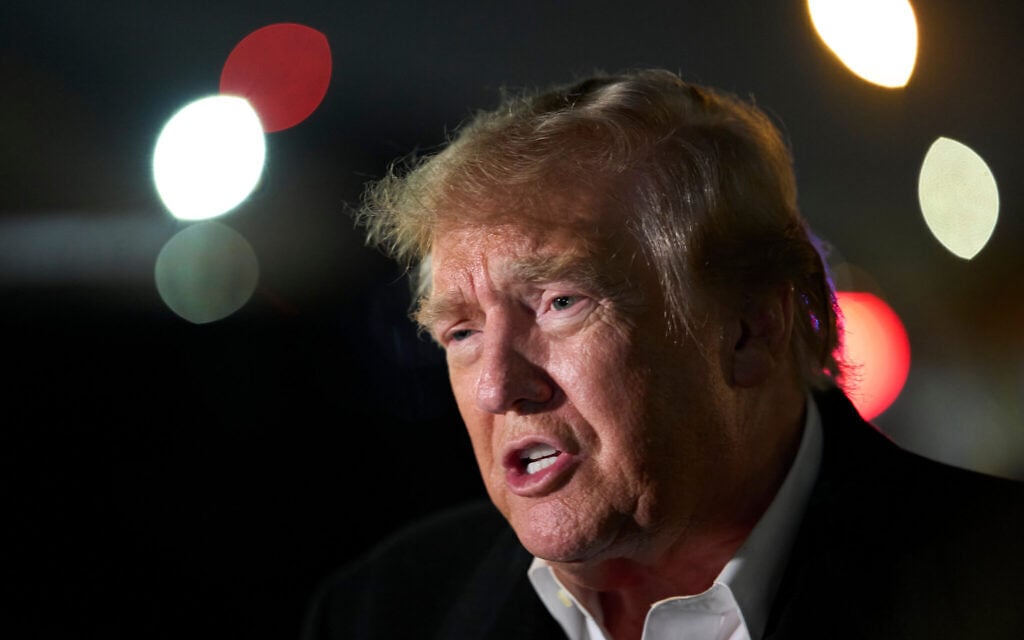
- Campaign Rally Statements: Speaking at events in Corpus Christi and Lubbock, Texas, President Donald Trump proposed converting
 Venezuela into the 51st U.S. state governed by an elected chief executive (MercoPress).
- Foreign Diplomatic Visas: The administration confirmed it will grant entry visas to defeated
 Brazilian Senator Flávio Bolsonaro and his family after Bolsonaro departed Brazil despite an active court-ordered travel restriction (Al-Monitor).
- Diplomatic Scheduling: President Trump announced plans to organize a direct meeting with Russian President Vladimir Putin and Ukrainian President Volodymyr Zelenskyy (Meduza).
 Global Dynamics

- Spanish Rail Accident: Emergency crews responded near Toledo, Spain, where a high-speed train collided with the rear of a stationary train, derailing two cars and killing at least 10 individuals (NYT World).
 British Monarchy Tour: King Charles III initiated a nine-day official visit across the Caribbean—including stops in the Bahamas, Guyana, and Antigua and Barbuda—addressing historical ties (BBC World News).
 Italian Inflation Demonstrations: Student organizations in northern Italian cities and freight truckers in southern regions mounted public demonstrations protesting energy prices and living costs (NYT World).
 Tech & Trade Rivalries

- Semiconductor Supply Outlook:
 South Korea's SK Hynix warned that high-bandwidth memory chip supply constraints will extend through 2030 due to persistent enterprise demand (MarketWatch).
- Space Operations Intelligence: The U.S. Defense Intelligence Agency released an imagery analysis detailing
 China's reusable experimental spaceplane, drawing structural comparisons to the U.S. Space Force X-37B (Militarnyi).
- Asian Equity Markets:
 Taiwan's Taiex index climbed over 900 points to close above 47,000, boosted by technology stocks following Anthropic's draft S-1 pre-IPO filing (Focus Taiwan).
 Weather Desk: Storms and Weather in Progress
 Tropical Cyclone Arnab
maximum wind speed of 222 km/h, GDACS red alert affecting 4.008 million people
active in the North Indian Ocean near India
Day 3, tracked by GDACS since 26 October.
 NASA VIIRS, 27 October 2026
Sources: GDACS report
 On This Day: October 28, 2026

1965: St. Louis. Image: Sam valadi, CC BY 2.0, via Wikimedia Commons

 1997: Taylor Fritz, American professional tennis player and ATP Tour titlist.
- 1987: Frank Ocean, Grammy Award-winning American singer, songwriter, and musician.
- 1984: Finn Wittrock, American actor known for roles in film and television.
 1965: Construction completed in St. Louis, Missouri, on the 630-foot steel catenary Gateway Arch.
- 1925: Explorers uncovered the golden funerary mask of Tutankhamun for the first time in roughly 3,250 years.
- 1919: The U.S. Congress passed the Volstead Act over President Woodrow Wilson's veto, establishing legal enforcement mechanisms for Prohibition.
 The American Experience: Did You Know?
 The Curved Logic of the Four-Leaf Cloverleaf
Civil engineer Arthur Hale patented the cloverleaf interchange design in 1928 to resolve a growing highway safety problem: vehicles turning left across incoming traffic lanes. The Maryland State Roads Commission built the nation's first functional cloverleaf in 1929 at Woodbridge, New Jersey, forcing left-turning cars to make a continuous 270-degree right ramp loop instead of crossing open highway lanes.
 The History Desk:
 East Asia
Hostages on the Highway: The Economics of Sankin-KōtaiEdo Japan · 1635–1862
Japan · 1635–1862
Image: a former retainer, Public domain, via Wikimedia Commons

In 1635, Shōgun Tokugawa Iemitsu institutionalized sankin-kōtai (alternate attendance), requiring all provincial feudal lords (daimyō) to reside in the capital city of Edo every other year while leaving their primary wives and heirs behind as permanent political hostages. Moving hundreds of samurai, retainers, and supplies along Japan's five main highway routes forced regional lords to spend between 50% and 75% of their total domain budgets on logistics, travel accommodations, and maintaining separate mansions in Edo. This forced expenditure successfully prevented armed provincial rebellions by steadily draining domain treasuries while sparking rapid urbanization, commercial trade networks, and post-station infrastructure along the Tōkaidō road.
Japan's five main highway routes forced regional lords to spend between 50% and 75% of their total domain budgets on logistics, travel accommodations, and maintaining separate mansions in Edo. This forced expenditure successfully prevented armed provincial rebellions by steadily draining domain treasuries while sparking rapid urbanization, commercial trade networks, and post-station infrastructure along the Tōkaidō road. Why today: This economic drain of maintaining dual residences and constant travel mirrors how U.S. Senate candidates are spending record out-of-state fundraising dollars while managing travel schedules across multiple jurisdictions six days before the midterm elections (NPR).